
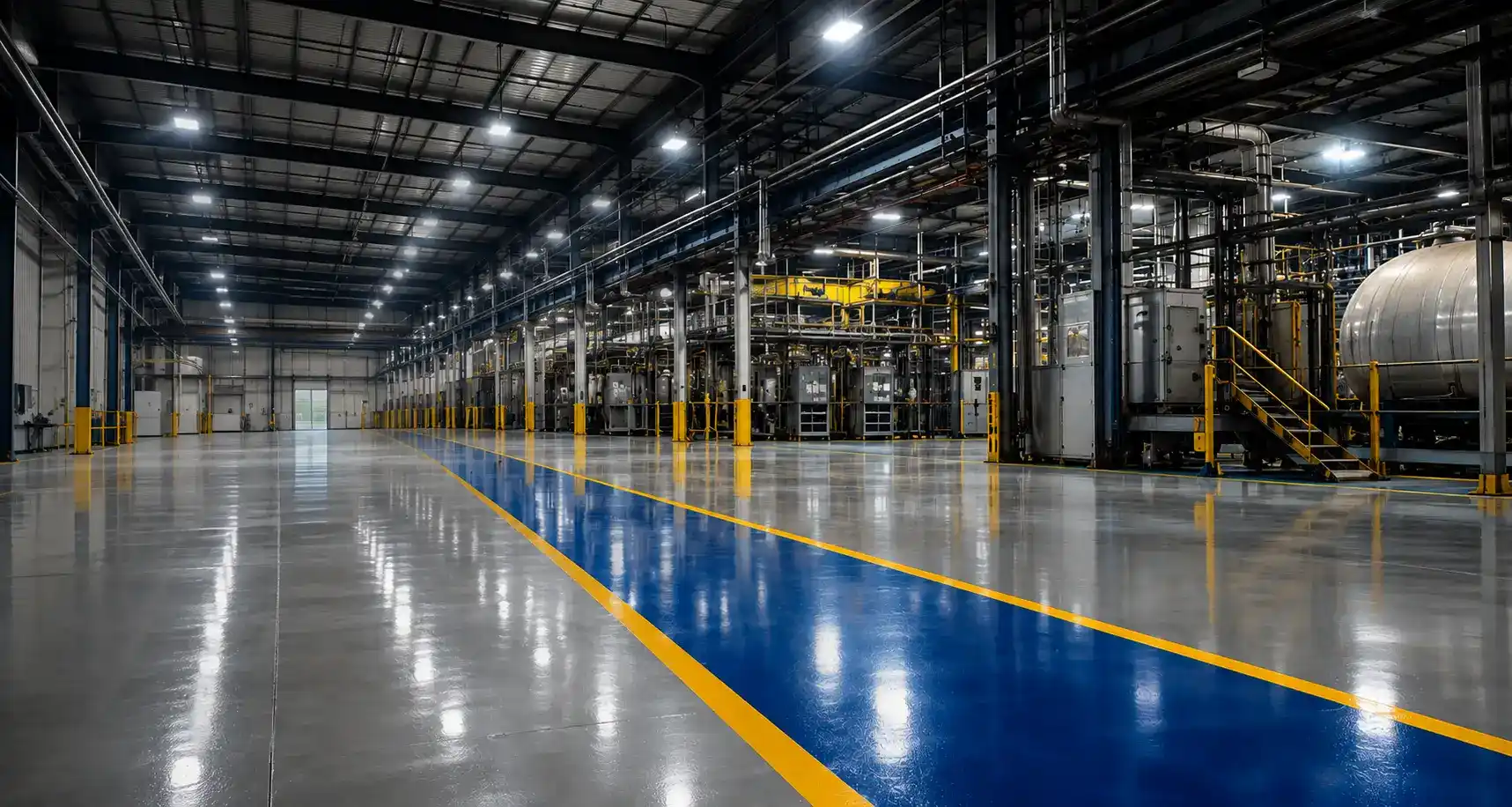
Industrial flooring requires a properly prepared foundation to achieve reliable performance. Uneven concrete surfaces, minor depressions and damaged floor sections can affect the quality of epoxy flooring installation.
Applying epoxy directly over unsuitable surfaces may lead to inconsistent coating thickness, poor adhesion and premature deterioration.
Professional Floor Levelling Screed Services in India help industrial and commercial facilities prepare suitable flooring foundations before applying protective finishes.
Understanding the importance of floor levelling allows businesses to make informed decisions and avoid unnecessary flooring maintenance expenses.
What Is Floor Levelling Screed?
Floor levelling screed is a cement-based or specially formulated material applied over an existing substrate to correct surface irregularities and achieve the required floor level.
It provides a suitable foundation for subsequent flooring materials, including epoxy, polyurethane and tiles.
Depending on project requirements, contractors may use conventional cement-sand screeds, polymer-modified materials or self-smoothing compounds.
The appropriate system depends on concrete conditions, correction depth, expected traffic and final flooring specifications.
6 Reasons Why Floor Levelling Screed Is Important Before Epoxy Flooring
1. Corrects Uneven Concrete Surfaces
Concrete floors may develop irregularities during construction or through years of industrial use.
Surface depressions and raised sections can affect the appearance and functionality of the finished floor.
Professional uneven floor levelling addresses suitable surface irregularities and establishes the required foundation for epoxy installation.
Contractors should inspect existing floor conditions to determine whether grinding, localised repairs or screed application is necessary.
2. Supports Better Epoxy Coating Adhesion
Epoxy coatings require a clean, stable and properly prepared substrate for effective bonding.
A compatible screed provides a suitable surface for subsequent coating application when installed and prepared correctly.
However, damaged concrete, contamination and active cracks require attention before levelling begins.
Facilities experiencing extensive surface deterioration may require professional Floor Repair & Recoating services to address existing defects before installing a new flooring system.
3. Helps Maintain Consistent Coating Thickness
Installing epoxy over irregular surfaces can result in inconsistent material distribution.
Depressions may consume additional resin, while raised areas may receive insufficient coating thickness.
Preparing a suitable level surface helps contractors achieve the specified coating thickness more consistently.
This also supports material planning and reduces avoidable resin consumption during installation.
4. Improves Material Handling Conditions
Factories and warehouses rely on forklifts, pallet trucks and other material handling equipment for daily operations.
Uneven surfaces can increase equipment vibrations and create difficulties during material transportation.
A properly designed Floor Levelling Screed system helps establish smoother movement routes within industrial facilities.
The selected system must accommodate anticipated floor loads, traffic intensity and operational requirements.
5. Supports a Consistent Finished Appearance
Industrial facilities often require smooth flooring surfaces that simplify cleaning and support organised working environments.
A suitable levelling layer helps reduce visible surface irregularities beneath the finished flooring system.
Businesses requiring seamless surfaces may consider Self-Leveling Epoxy Flooring after completing necessary substrate preparation.
This combination can support a consistent finish in compatible manufacturing, pharmaceutical and commercial environments.
6. Helps Reduce Avoidable Maintenance Expenses
Poor substrate preparation can contribute to coating failure, cracking and repeated restoration requirements.
Correcting floor irregularities before epoxy installation helps address suitable surface defects at the preparation stage.
Although levelling adds to the initial project cost, proper substrate preparation may reduce unnecessary future repairs.
Businesses should evaluate the complete flooring system rather than focusing exclusively on coating installation charges.
Types of Floor Levelling Screed for Industrial Applications
| Screed Type | Typical Thickness | Suitable Application |
|---|---|---|
| Cementitious Screed | 25–75 mm | General floor level corrections |
| Polymer-Modified Screed | Product-dependent | Localised repairs and improved bonding |
| Self-Levelling Compound | 2–10 mm | Minor surface irregularities |
| Heavy-Duty Screed | System-dependent | Industrial areas requiring a robust base |
These thickness ranges are indicative. Final specifications depend on product requirements, substrate conditions and anticipated floor loads.
How Is Floor Levelling Screed Applied?
A professional floor levelling project generally involves the following stages:
- Site assessment: Inspect existing concrete and identify surface irregularities.
- Surface preparation: Remove contaminants, weak concrete and unsuitable coatings.
- Surface repairs: Address cracks, damaged joints and localised defects.
- Priming: Apply a compatible bonding agent where required.
- Screed application: Mix and apply the selected levelling material.
- Curing: Allow sufficient drying and curing according to product specifications.
- Final inspection: Verify surface condition and readiness for the subsequent flooring finish.
Proper moisture assessment is particularly important before applying epoxy coatings.
Floor Screed vs Self Levelling Screed
Traditional cement-based screeds are generally considered for larger level corrections and applications requiring manually formed surfaces.
A self levelling screed or self-smoothing compound is designed to spread across properly prepared surfaces and correct suitable irregularities within its specified application thickness.
Both systems serve different purposes. Contractors should select materials according to correction depth, operational requirements and compatibility with the final flooring finish.
Why Choose CoatEXX Industrial Solutions?
CoatEXX Industrial Solutions provides customised Floor Levelling Screed solutions for factories, warehouses, manufacturing plants and commercial facilities across India.
The company evaluates substrate conditions, required level corrections, floor loads and final finish specifications before recommending an appropriate system.
Its approach includes site assessment, surface preparation, material selection, application and final inspection.
Conclusion
Floor levelling screed plays an important role in preparing industrial surfaces before epoxy flooring installation. Proper levelling, compatible material selection and adequate curing can support better adhesion, consistent flooring thickness and long-term surface performance.
Contact CoatEXX Industrial Solutions today for professional floor levelling and customised industrial flooring solutions.
Email: [email protected]
Phone: +91-86570-78306
Address: 204, Shreeji Apartment, Bonkonde, Tal. Kalyan, Thane, Maharashtra – 421301
Frequently Asked Questions (FAQs)
1. Is floor levelling screed necessary before epoxy flooring?
It is recommended when existing surface irregularities exceed the tolerances of the selected epoxy flooring system.
2. What is the difference between traditional screed and self levelling screed?
Traditional screed generally requires manual levelling, while self-levelling compounds flow across prepared surfaces to correct suitable irregularities.
3. Can floor levelling screed repair damaged concrete?
It can correct suitable surface defects, but structural damage and active cracks require appropriate assessment and repairs.
4. How long does floor levelling screed take to cure?
Curing and drying times depend on material specifications, application thickness, temperature and moisture conditions.
5. What affects the cost of floor levelling screed services in India?
Floor area, correction depth, material selection, substrate condition, surface preparation and labour requirements influence project costs.